
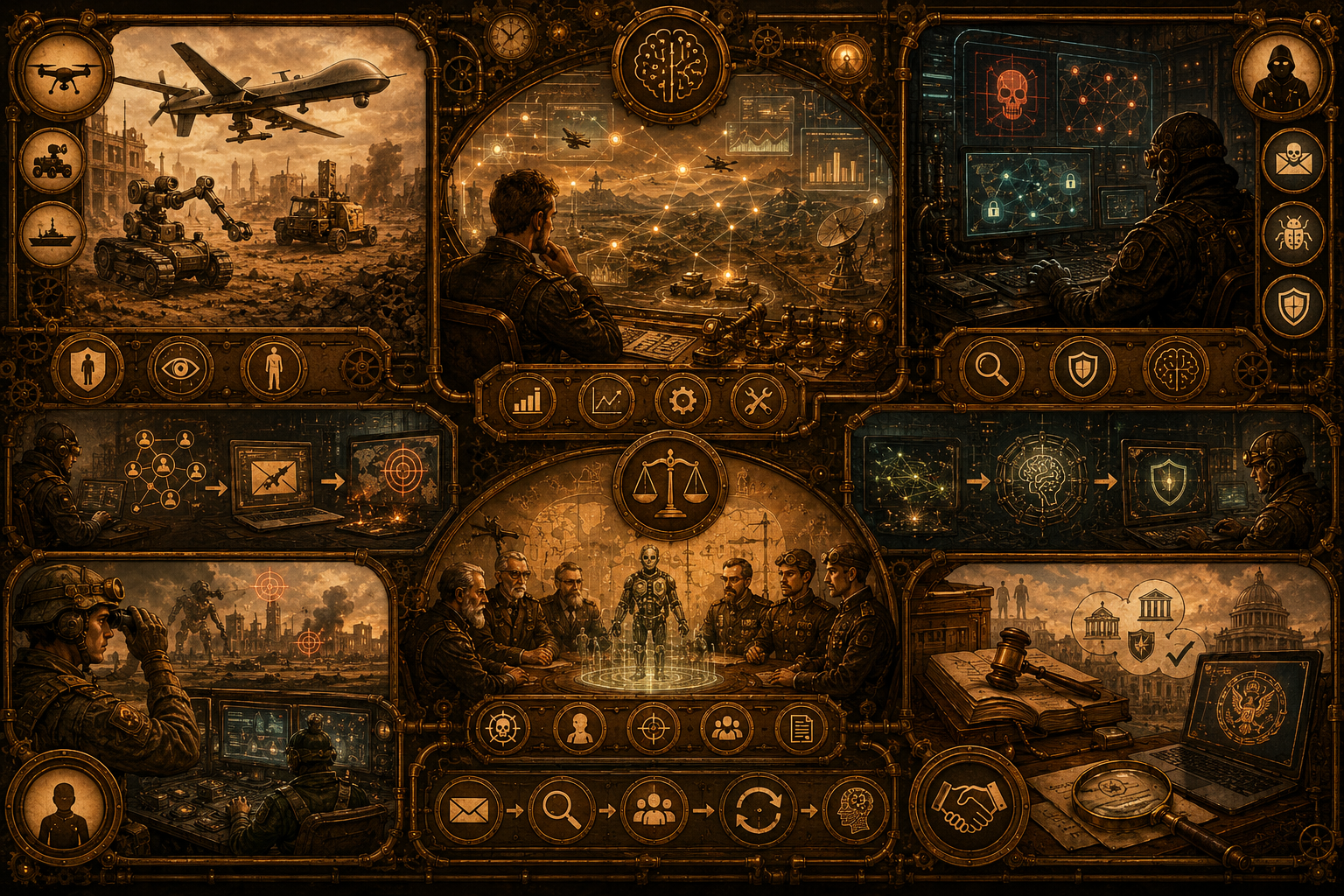
War has always been shaped by the technology available to those who wage it. The bow and arrow, gunpowder, the tank, the aircraft, the nuclear weapon — each represented a fundamental shift in the nature of conflict, forcing a renegotiation of tactics, strategy, and the moral frameworks within which violence is conducted. Artificial intelligence is the latest in this long sequence of transformative military technologies, and there is a strong case to be made that it is the most consequential of all. Not because it makes weapons more powerful in the simple sense of being more destructive, but because it changes something more fundamental — the relationship between human decision-making and the use of force. When a weapon can identify a target, evaluate a situation, and take action without a human being in the loop, the question of who is responsible for what happens on a battlefield becomes genuinely difficult to answer. That question — and the many related questions it opens up about accountability, ethics, law, and the future of armed conflict — is one that the world’s militaries, governments, and international institutions are only beginning to grapple with seriously. Understanding where artificial intelligence is currently being applied in modern warfare, and what those applications mean for the human beings on all sides of the conflicts they are deployed in, is an urgent task that goes well beyond military strategy.
Autonomous systems: the rise of machines that make their own decisions
Perhaps the most striking and widely discussed application of artificial intelligence in modern warfare is the development and deployment of autonomous systems — unmanned vehicles and robotic platforms equipped with AI algorithms capable of making independent decisions in combat environments. The range of these systems is already considerable and growing rapidly. Unmanned aerial vehicles, ground-based robots, and naval drones are all active areas of development across multiple militaries, with the United States among the most advanced in deploying such systems operationally.
The MQ-9 Reaper drone represents one of the most visible examples of AI-enabled autonomous military capability. Equipped with advanced artificial intelligence that allows it to conduct surveillance, reconnaissance, and targeted strikes with minimal human intervention, it has been deployed extensively in conflict zones and has fundamentally changed the operational calculus of aerial operations. Ground-based systems like the TALON and PackBot robots have been used for tasks ranging from bomb disposal in urban environments to reconnaissance in areas considered too dangerous for human soldiers. These platforms offer genuine operational advantages that are difficult to dismiss — they reduce the physical risk to human military personnel, can operate continuously without fatigue, and are capable of functioning in environments that would be lethal or inaccessible to humans.
But the advantages come with a set of ethical and practical concerns that are equally difficult to dismiss. The prospect of a machine making an independent decision to use lethal force — selecting a target, assessing a threat, and acting on that assessment without a human being making or approving that judgment in real time — raises profound questions that existing legal and ethical frameworks were not designed to answer. The laws of armed conflict, developed over centuries of human warfare, are built on the assumption that a human being is responsible for the decisions made in combat. When that assumption no longer holds, questions of proportionality, distinction between combatants and civilians, and accountability for wrongful harm become genuinely difficult to resolve. A drone that kills the wrong person cannot be prosecuted. The programmer who wrote its targeting algorithm may be far removed from the operational context. The commander who authorized its deployment may have had no knowledge of the specific decision it made. The gap between action and responsibility that autonomous systems create is not just a theoretical concern. It is a practical challenge that militaries and legal scholars are actively wrestling with, without yet having arrived at satisfying answers.
AI-driven decision support: intelligence, prediction, and the risk of algorithmic error
Beyond autonomous weapons systems, artificial intelligence is playing an increasingly central role in the analytical and decision-support infrastructure that military commanders rely on to make operational decisions. The sheer volume of data generated in modern warfare — from sensors, satellites, intelligence reports, communications intercepts, and real-time battlefield feeds — far exceeds the capacity of any human analyst or team to process manually. AI-driven analytics systems are designed to sift through this data at scale, identifying patterns, forecasting enemy movements, flagging potential threats, and providing commanders with synthesized intelligence that supports faster and better-informed decision-making.
The United States Department of Defense has invested heavily in this area, developing systems like the Joint All-Domain Command and Control framework, which uses artificial intelligence to integrate data across land, sea, air, space, and cyberspace domains simultaneously, providing commanders with a unified operational picture that would be impossible to construct manually in anything like real time. Predictive maintenance represents another significant application — AI algorithms that monitor the condition of military equipment and predict failures before they occur, reducing operational downtime and enabling more efficient allocation of maintenance resources. In both cases, the potential advantages are real and significant. Faster, better-informed decisions can save lives and reduce the duration and destructiveness of conflicts. More reliable equipment means fewer operational failures at critical moments.
The risks, however, are equally real. Machine learning algorithms are trained on historical data, and the biases and gaps in that data propagate directly into the predictions and recommendations the algorithms produce. In a military context, a biased algorithm does not just produce an inaccurate report — it can produce a recommendation that leads to the use of force in the wrong place, against the wrong people, based on pattern-matching that reflects the limitations of its training rather than the reality of the current situation. The opacity of many AI systems compounds this problem significantly. When an algorithm produces a recommendation, it is often extremely difficult — even for experts — to understand precisely why it produced that recommendation or what assumptions underlie it. In a business context, this opacity is a problem. In a military context, where the consequences of errors are measured in human lives, it is a profound ethical and operational challenge that the responsible use of AI in decision support must address directly.
AI in cyber warfare: the digital battlefield and its escalating dangers
The application of artificial intelligence in cyber warfare represents one of the most consequential and least publicly visible dimensions of the AI-in-conflict story. AI-powered cyber capabilities are already being used by state and non-state actors to attack enemy networks, disrupt critical infrastructure, develop and deploy sophisticated malware, and evade the detection systems designed to stop them. What makes AI particularly transformative in this domain is its ability to automate and accelerate processes that previously required significant human expertise and time.
AI-powered phishing attacks, for example, can analyze the communication patterns, professional relationships, and behavioral characteristics of specific targets to craft highly personalized and convincing deceptive messages at scale — a capability that dramatically increases the effectiveness of social engineering attacks against even security-aware targets. Vulnerability scanning algorithms can systematically probe software and network architectures for exploitable weaknesses far faster than human security researchers, identifying zero-day vulnerabilities that can be weaponized before defenders have even become aware of them. Malware powered by AI can adapt its behavior in real time in response to the defensive measures it encounters, making it significantly harder to detect and contain using traditional security approaches.
Militaries facing these threats are responding by investing in defensive AI capabilities designed to operate at the same speed and scale as the attacks themselves. Machine learning systems that monitor network traffic for anomalous behavior, detect indicators of compromise in real time, and autonomously isolate affected systems are being developed and deployed as essential components of modern cyber defense infrastructure. The problem is that this dynamic creates an escalating cycle of offense and defense in which both sides are continuously developing and deploying more capable AI systems, with each advance on one side prompting a corresponding advance on the other. The risks of miscalculation and unintended escalation in this environment are significant. A highly capable AI-driven cyber attack against critical infrastructure — power grids, financial systems, communications networks — could produce consequences that neither the attacker nor any human decision-maker fully anticipated, potentially triggering a conflict that no one intended to start.
Ethics, law, and the urgent need for international frameworks
The deployment of artificial intelligence in warfare at the scale and pace currently underway has outrun the ethical and legal frameworks designed to govern the use of force. This is not a novel problem in the history of military technology — the development of new weapons has consistently preceded the development of the norms and laws designed to constrain their use. But the speed and breadth of AI’s application in modern conflict, combined with the fundamental questions it raises about human control and accountability, make the gap between technological reality and regulatory framework particularly acute and particularly dangerous.
The Geneva Conventions and the broader body of international humanitarian law are built on principles — distinction between combatants and civilians, proportionality in the use of force, military necessity — that assume human judgment is being applied in the decisions that determine how and when force is used. When AI systems are making or substantially influencing those decisions, the application of these principles becomes genuinely problematic. Can an autonomous weapons system meaningfully apply the principle of proportionality — the requirement that the anticipated harm to civilians not be excessive in relation to the military advantage sought? Can it make the contextual judgments about intent, threat level, and civilian status that international law requires? Most experts who have examined these questions carefully conclude that current AI systems cannot, and that deploying lethal autonomous systems without meaningful human control therefore places military operations outside the bounds of what existing international law was designed to sanction.
Efforts to address this gap are underway, though they face significant challenges. The Campaign to Stop Killer Robots has advocated for a preemptive international ban on autonomous weapons systems capable of selecting and engaging targets without human control. The United Nations Group of Governmental Experts on Lethal Autonomous Weapons Systems has been engaged in multilateral discussions about the legal and ethical challenges these systems present and the options available for international regulation. Progress has been slow, partly because the states most actively developing these capabilities have significant interests in preserving their operational freedom, and partly because the technical complexity of defining exactly what constitutes meaningful human control in an AI-assisted military operation makes agreement on specific regulatory language difficult. The urgency of reaching that agreement, however, is difficult to overstate.
The human cost of AI warfare: psychological and societal dimensions
Any serious discussion of artificial intelligence in modern warfare must engage with the human dimensions of what these technologies produce — not just in terms of legal accountability, but in terms of psychological and societal impact. For the soldiers who operate AI-enabled systems, the psychological experience of warfare is changing in ways that are only beginning to be understood. Drone operators who conduct targeted strikes remotely, using AI-assisted targeting systems, report psychological experiences that differ significantly from those of traditional combat — including forms of moral injury related to the difficulty of processing responsibility for lethal decisions made at a distance, mediated by technology, without the visceral reality of physical presence.
For the civilian populations who live in areas where AI-enabled military systems operate, the psychological impact is equally significant and largely underdiscussed. The persistent presence of surveillance drones, the knowledge that lethal systems are operating in one’s environment and making decisions that could affect one’s life, and the profound asymmetry of power that these technologies represent all contribute to forms of psychological distress — chronic anxiety, hypervigilance, trauma — that extend far beyond any specific incident. At the societal level, the militarization of AI raises broader questions about the kind of world that these technologies are building — a world in which the barriers to the use of lethal force are lower, in which the distance between decision and consequence is greater, and in which the accountability structures that have historically constrained the use of military power are being quietly eroded by technologies that make human responsibility harder to assign and harder to enforce. These are not abstract concerns. They are questions about the future of human security, human dignity, and the social fabric that holds communities and nations together in the face of conflict. And they deserve to be part of every serious conversation about the role of artificial intelligence in modern warfare.
