
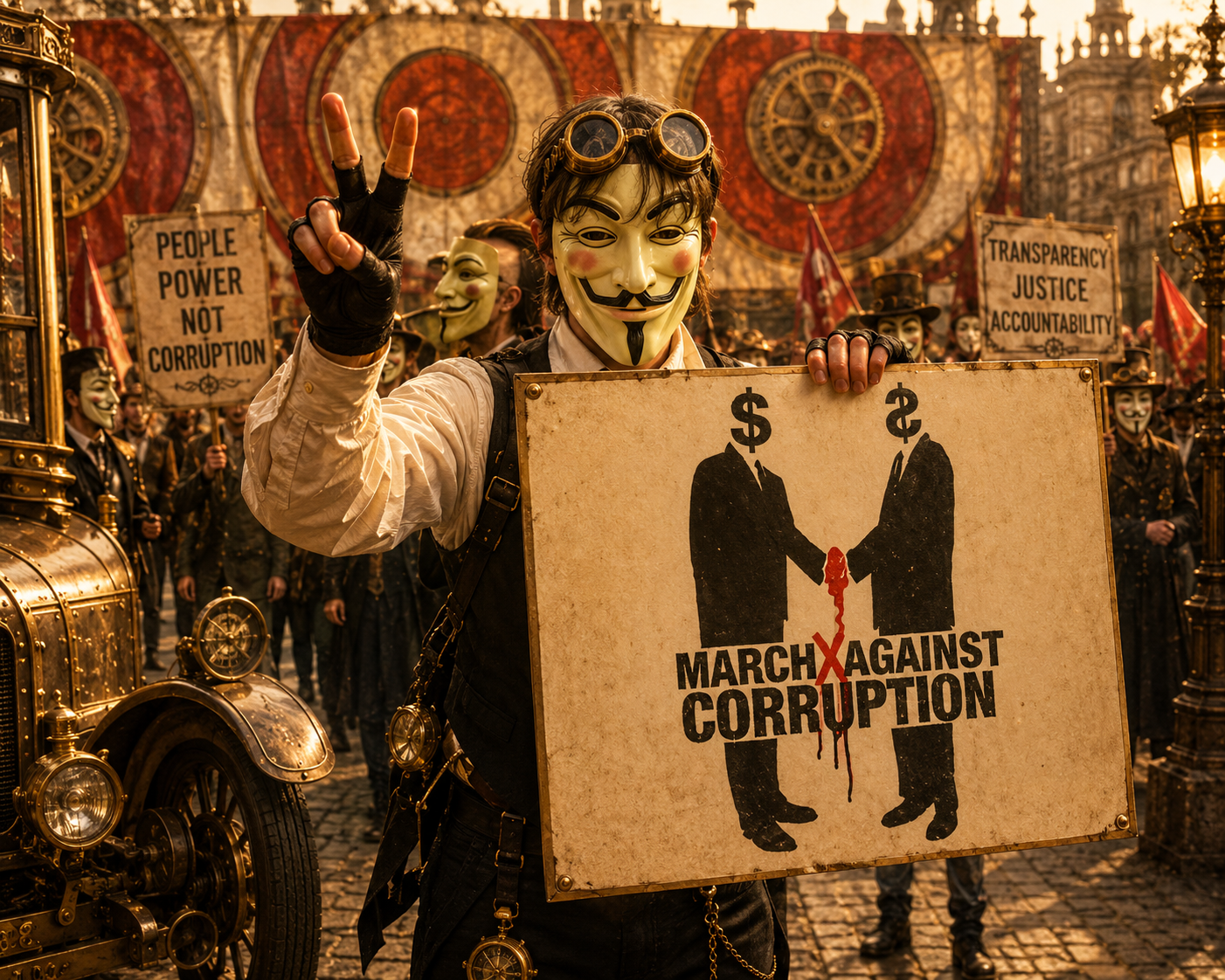
There is an implicit agreement at the heart of every functioning society — a social contract, as political philosophers have called it for centuries, in which citizens grant authority to governing institutions in exchange for protection, fairness, and the advancement of collective wellbeing. This contract does not require citizens to agree with every policy or approve of every decision their government makes. It requires only that they believe, in a fundamental sense, that the institutions governing them are operating in good faith, within legitimate boundaries, and with some reasonable orientation toward the common good. When that belief erodes — when significant portions of a population stop trusting that their government is honest, competent, or genuinely interested in their welfare — the consequences extend far beyond politics. They reach into the psychology of individuals, the fabric of communities, and ultimately into patterns of behavior that include, in measurable and documented ways, the commission of crime. Understanding why requires looking not just at political science but at the psychological mechanisms through which distrust operates, accumulates, and eventually translates into social breakdown.
The historical roots of institutional distrust
Trust in government is not a static condition. It is built and eroded over time through the accumulation of experience — and some experiences leave marks that persist for generations. Historical events of governmental betrayal have a psychological staying power that is difficult to overstate. They become reference points in collective memory, touchstones that shape how subsequent generations interpret governmental behavior long after the original events have passed.
The Watergate scandal remains one of the most instructive examples in the modern democratic world. The discovery that the Nixon administration had engaged in illegal surveillance, political sabotage, and systematic efforts to cover up its own misconduct did not merely damage one presidency. It produced a lasting transformation in how Americans related to the idea of governmental authority — a shift toward a baseline skepticism that became, for many people, simply the default posture toward government. Before Watergate, polling consistently showed majority trust in federal institutions. After it, that majority trust has never fully recovered. The scandal did not just reveal a specific wrongdoing. It revealed that the most powerful office in the country was capable of systematic deception, and that revelation lodged itself in the cultural consciousness in ways that continued to shape political attitudes decades later.
This pattern is not unique to the United States. Corruption scandals, instances of governmental abuse, and high-profile failures of public institutions have left similar marks in democracies around the world. What these events share is their capacity to shift the psychological baseline from which citizens interpret subsequent governmental behavior. Once trust has been seriously damaged by a visible betrayal, it creates a perceptual frame through which new information is filtered — and that frame, as we will explore, tends to be self-reinforcing in ways that make rebuilding trust extraordinarily difficult.
Transparency, inequality, and the perception of a rigged system
Two of the most consistent drivers of institutional distrust in contemporary societies are the perceived lack of governmental transparency and the visible reality of economic inequality. These are distinct phenomena, but they tend to operate together in psychologically powerful ways, reinforcing each other’s corrosive effects on public trust.
When governments make decisions behind closed doors — when policies are developed without public input, when the rationale for consequential decisions is withheld from the people affected by them, when requests for information are deflected or denied — it creates a vacuum that the human mind does not leave empty. In the absence of transparent explanation, people construct their own narratives about what is being hidden and why. These narratives tend, quite understandably, toward the suspicious. The assumption that secrecy exists to protect the powerful at the expense of the powerless is not paranoia — it is a reasonable inference from a long historical record of exactly that. Governmental opacity therefore does not merely fail to build trust. It actively produces distrust by providing no alternative narrative to the one that suspicion naturally generates.
Economic inequality compounds this dynamic significantly. When a society is visibly stratified — when the gap between those who have resources, security, and opportunity and those who do not is large and growing — the perception that governmental institutions serve the interests of the affluent rather than the general population becomes increasingly difficult to resist. This is not solely a matter of objective policy analysis. It is a deeply felt psychological experience for people who see their own circumstances deteriorating while others accumulate wealth and influence without apparent consequence. The belief that the system is rigged — that laws are made by the powerful for the powerful, that enforcement is selectively applied, that the social contract has been broken by the very institutions charged with upholding it — is a belief that emerges naturally from the lived experience of inequality. And it has direct and serious implications for how people relate to the law.
The psychology of distrust: cognitive mechanisms that deepen the divide
The process through which institutional distrust deepens and becomes entrenched is not random. It follows recognizable psychological patterns that, once understood, explain why distrust tends to be self-perpetuating and why efforts to rebuild it through straightforward communication so often fail.
Confirmation bias is perhaps the most important of these mechanisms. It describes the deeply ingrained human tendency to seek out, notice, and remember information that confirms existing beliefs while discounting or overlooking information that challenges them. For someone who already distrusts their government, every new scandal, every failed policy, every instance of perceived hypocrisy or corruption is vivid, salient, and memorable. Evidence of competence, honesty, or genuine public service is processed through a skeptical filter and tends not to significantly update the underlying negative assessment. The result is a perceptual environment in which distrust feeds on itself — each confirming experience makes the lens more fixed, the skepticism more entrenched, and the possibility of genuine trust restoration more remote.
Cognitive dissonance operates alongside confirmation bias to deepen the psychological experience of institutional distrust. When citizens hold values of fairness, transparency, and honest governance — as most people genuinely do — and simultaneously witness governmental behavior that violates those values, they experience the uncomfortable internal tension that psychologists call cognitive dissonance. This discomfort motivates resolution, and the available resolutions tend to move in one direction: toward a more cynical assessment of governmental institutions. It is psychologically easier to conclude that the government is corrupt than to hold simultaneously the belief that governance should be ethical and the experience that it frequently is not. Cynicism, however uncomfortable it may be, at least has the virtue of internal consistency.
Loss aversion adds yet another dimension to this picture. Research in behavioral psychology has consistently demonstrated that people feel the pain of losses more intensely than they feel the pleasure of equivalent gains. In the context of institutional trust, this means that governmental failures — broken promises, mishandled crises, betrayals of public confidence — register more powerfully and persistently in public consciousness than governmental successes. A government that successfully manages ten crises and catastrophically fails one will be remembered primarily for the failure. The psychological asymmetry between loss and gain means that trust, once damaged, requires substantially more positive experience to rebuild than negative experience required to damage it. This is one of the most important and least appreciated reasons why institutional trust, once eroded, is so difficult to restore.
The media environment and the amplification of distrust
The role of media in shaping and amplifying institutional distrust deserves particular attention, especially in an era when the media landscape has fragmented into an ecosystem of competing narratives, polarized outlets, and algorithmically curated information environments. Media has always played a role in shaping public perceptions of government — investigative journalism has historically been an essential check on governmental abuse, and the coverage of genuine scandals and failures is a legitimate and vital function. The challenge arises when media coverage is systematically biased toward the sensational, the negative, and the conflict-driven in ways that distort the overall picture of governmental performance and capacity.
When audiences are continuously exposed to a media environment that emphasizes governmental failure, corruption, and incompetence — whether through genuine investigative reporting, partisan framing, or the simple commercial logic of a media industry that has learned that outrage and alarm drive engagement more effectively than reassurance — the cumulative psychological effect is a baseline of suspicion that colors the interpretation of everything that follows. Combined with the echo chamber dynamics of contemporary social media, where algorithmic curation tends to feed people more of what already aligns with their existing perspectives, the result is an information environment that is structurally biased toward the deepening of distrust rather than its repair.
From distrust to defiance: the pathway to criminal behavior
The connection between institutional distrust and criminal behavior is not simple or deterministic. Not everyone who distrusts their government commits crimes, and many crimes are committed by people who have no particular grievance against governmental institutions. But the relationship between low institutional trust and elevated crime rates is documented across multiple research traditions, and the psychological mechanisms through which distrust contributes to criminal behavior are worth examining carefully.
The most direct pathway runs through the perceived legitimacy of law. Laws derive their practical authority not merely from the threat of enforcement but from the belief of the governed that they are fair, reasonable, and oriented toward collective wellbeing. When citizens trust their government and believe that laws reflect genuine social values rather than the interests of the powerful, voluntary compliance is high. When that trust erodes — when laws come to be perceived as arbitrary impositions by institutions that do not serve the common good — the moral obligation to comply weakens significantly. People who do not believe that the law is legitimate do not feel morally bound by it in the same way that people who accept that legitimacy do. This does not mean they will necessarily break the law, but it does mean that the psychological cost of doing so is lower, and that the threshold of provocation or opportunity required to trigger noncompliance is reduced.
For some individuals, particularly those in communities that have experienced sustained governmental neglect, discrimination, or active harm, this perception of illegitimacy extends to a sense of active moral justification for rule-breaking. When the law is experienced not as a neutral framework for collective life but as a tool of oppression wielded by institutions that have consistently failed or harmed one’s community, resistance to that law can be psychologically framed not as deviance but as a legitimate response to injustice. This framing does not make criminal behavior morally defensible in an objective sense, but understanding it is essential for anyone who wants to address the relationship between institutional distrust and crime seriously rather than simply moralizing about it.
Social cohesion, community breakdown, and the crime prevention deficit
Beyond the individual level, institutional distrust has significant consequences for social cohesion — the degree of connectedness, mutual trust, and cooperative orientation among members of a community — and through social cohesion, for the informal mechanisms that communities use to prevent and respond to crime.
Research consistently shows that strong social cohesion is one of the most effective crime prevention factors available. Communities with high levels of mutual trust and cooperation maintain informal networks of surveillance, support, and accountability that deter criminal behavior and facilitate rapid response when it occurs. Neighbors watch out for each other. People are willing to intervene when they observe something wrong. Residents report criminal activity to authorities because they believe those authorities will respond appropriately and because they feel a sense of shared responsibility for community safety.
When institutional distrust is high, these informal mechanisms break down. Communities where residents distrust the police and other governmental institutions are communities where crime reporting is low, where cooperation with law enforcement is minimal, and where the informal accountability networks that deter criminal behavior are weakened. This creates conditions in which criminal activity can proliferate with less resistance, less reporting, and less effective response. The distrust of governmental institutions cascades into a distrust of the formal systems designed to maintain safety, and the resulting gap in protective infrastructure falls most heavily on the communities that are already most disadvantaged — those that have the strongest historical reasons for their distrust.
Political instability as both symptom and accelerant
At the extreme end of the spectrum, severe and widespread institutional distrust can contribute to political instability — and political instability, in turn, creates conditions that are highly conducive to increases in criminal activity. When governmental authority is contested, when law enforcement institutions are weakened by political conflict or loss of legitimacy, and when the social contract is openly repudiated by large segments of the population, the structural conditions that normally constrain criminal behavior are significantly degraded.
Power vacuums created by political instability are reliably exploited by criminal enterprises. Organized crime flourishes where governance is weak. Corruption becomes more prevalent when accountability mechanisms are undermined by political conflict. The resources and attention of governmental institutions shift toward managing political crises, reducing their capacity to maintain law and order effectively. The communities most exposed to these dynamics are, again, those with the least power to insulate themselves from the consequences.
The lesson that this pattern teaches is ultimately a constructive one, even if its context is troubling. Institutional trust is not merely a feel-good aspiration or a measure of political sentiment. It is operational infrastructure for a functioning society — the invisible architecture that makes voluntary compliance with law possible, that sustains the social cohesion that communities need to protect themselves, and that maintains the legitimacy of the governance structures that everyone depends on. Rebuilding it requires more than communication campaigns or transparency initiatives, though those matter. It requires the harder and more sustained work of governing in ways that genuinely merit trust — with accountability, with fairness, with responsiveness to the needs of all citizens rather than the most powerful, and with the long view that recognizes trust as the most valuable and most fragile resource that any government holds.
