
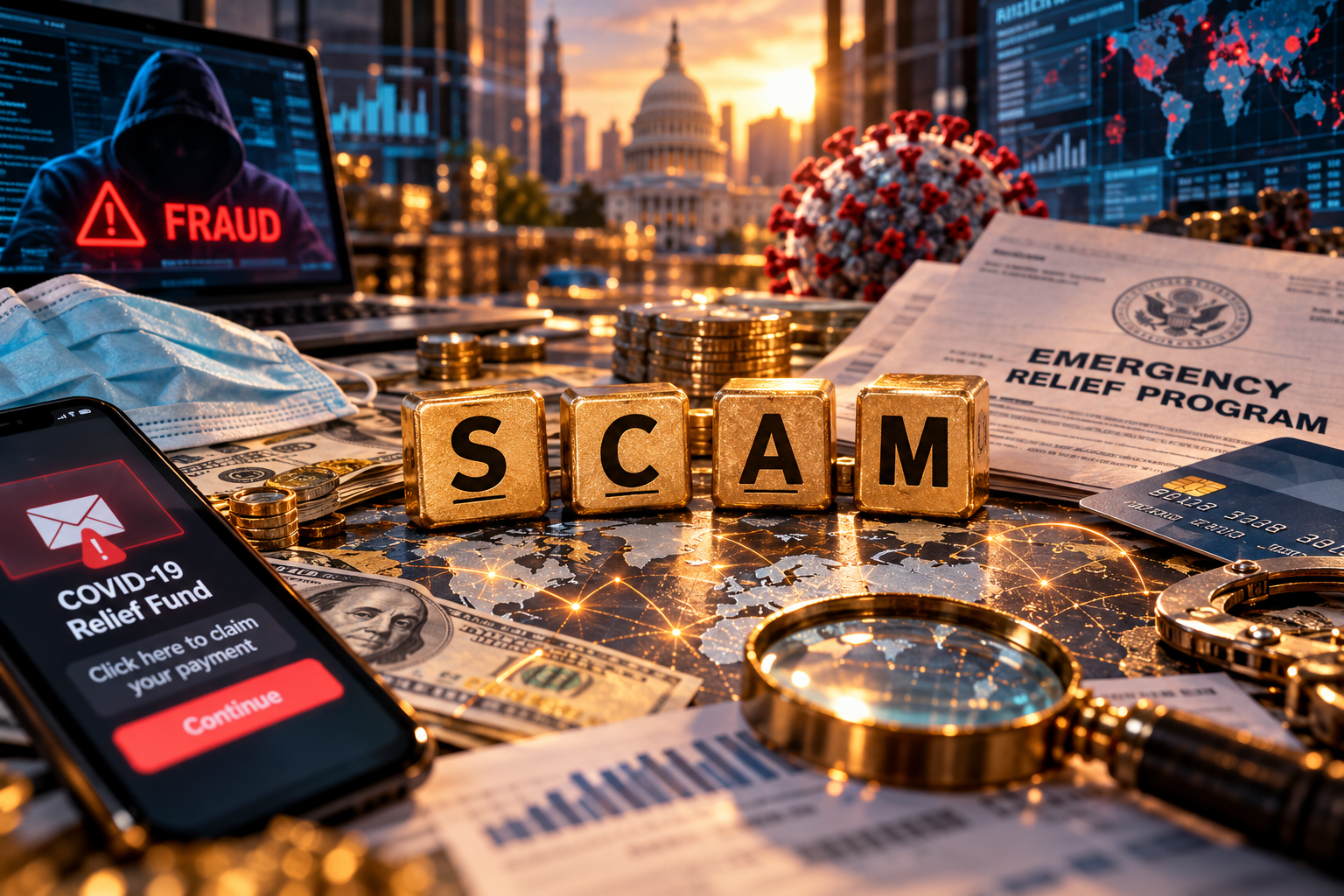
The COVID-19 pandemic created an unusual environment for financial crime because several conditions that fraudsters normally have to manufacture suddenly existed everywhere at once. People were frightened, financially uncertain and desperate for reliable information. Millions of employees began working remotely, businesses rapidly moved operations online, governments distributed enormous amounts of emergency financial assistance, and consumers who had previously conducted much of their lives offline became increasingly dependent on digital services. At the same time, familiar routines for verifying information were disrupted. An unexpected email from an employer no longer seemed unusual when company procedures were changing weekly. A government message about financial assistance was plausible because new relief programs really were being introduced. An investment promising to benefit from pandemic-related changes could sound credible when entire industries were being transformed almost overnight. Fraudsters did not create the crisis, but they were remarkably quick to recognize its psychological and financial possibilities. Identity theft became particularly damaging because stolen personal information could be used not only for conventional financial fraud but also to pursue pandemic-related benefits. Phishing campaigns adopted COVID-related themes because criminals understood that people were actively searching for information about health restrictions, vaccines, government payments, unemployment assistance and workplace policies. Investment fraud adapted to the same environment, promoting supposedly exceptional opportunities connected to pharmaceuticals, medical equipment, emerging technologies or industries expected to benefit from the crisis. Fake charities, counterfeit products and fraudulent websites exploited the desire to help or protect oneself. In the United States, emergency programs such as expanded unemployment benefits and the Paycheck Protection Program created another attractive target. These programs were developed under extraordinary pressure because their purpose was to move money quickly to people and businesses experiencing immediate economic distress. That speed was necessary, but it created a familiar security trade-off. Every additional verification step could delay assistance to legitimate applicants, while insufficient verification could allow fraudulent claims through. Criminals were operating inside precisely that gap. The result was not one new form of financial crime but a rapid adaptation of familiar forms of fraud to an environment in which urgency, confusion and unprecedented flows of money made deception easier to scale.
The psychology of the pandemic helps explain why these schemes could be so effective. Fraud is rarely based entirely on convincing someone of something absurd. Successful fraud more often attaches itself to something the victim already has reason to believe. During 2020 and 2021, uncertainty became normal. People genuinely were receiving unfamiliar communications from employers, banks, healthcare providers, government agencies and schools. Rules changed rapidly. New websites appeared. Businesses adopted unfamiliar technologies. Government programs were announced and modified. Against this background, determining which unusual communication was legitimate became substantially harder. Fear also affects decision-making. Under stress, people can focus more intensely on immediate threats and may have less cognitive capacity available for careful evaluation. A message claiming that a bank account has been compromised, benefits are about to expire or immediate action is required can exploit precisely this narrowing of attention. Financial hardship creates another vulnerability. Someone who has lost employment or watched a business deteriorate may evaluate a questionable investment or financial opportunity differently from someone who feels economically secure. The potential reward becomes emotionally more important because it appears to offer an escape from a real problem. Fraudsters have always exploited hope as effectively as fear, and the pandemic provided extraordinary quantities of both. Social isolation also mattered. Ordinary conversations with colleagues, friends and relatives can function as informal fraud detection. A suspicious request can be shown to the person at the next desk. An unusual investment can be discussed over dinner. Remote life weakened some of those spontaneous checks just as people were encountering more unfamiliar digital communication. The pandemic therefore demonstrates something important about cyberpsychology: vulnerability is situational. Intelligent and experienced people can make poor decisions when the environment changes faster than their mental models can adapt. Someone who would immediately recognize a suspicious email under normal circumstances might respond differently when the message concerns a new company procedure they have been expecting. A business owner who would ordinarily reject an improbable financial proposition may become more receptive while watching revenue collapse. The relevant question is not simply why people “fell for scams.” It is how criminals adapted their stories to circumstances in which those stories became temporarily more believable.
Technology magnified those psychological vulnerabilities. The transition to remote work occurred with extraordinary speed, and many organizations had little time to redesign security around a workforce suddenly operating outside traditional offices.
Employees connected from home networks and personal environments, relied more heavily on email and messaging, and sometimes adopted unfamiliar collaboration tools with minimal training. IT departments had to enable remote access while simultaneously responding to new operational demands. None of these changes automatically made remote work insecure, but rapid transformation can create gaps between established security controls and new patterns of behavior. Fraudsters and cybercriminals search for precisely those gaps. Business email compromise, phishing and impersonation become more convincing when employees cannot simply walk across an office to verify a request. A message apparently sent by an executive asking for an unusual payment may receive less immediate scrutiny when everyone is physically separated. Increased e-commerce produced another expansion of the potential attack surface. Consumers who previously purchased certain products in stores began entering payment and personal information into more websites. Delivery notifications became routine, giving phishing campaigns another credible disguise. Demand for masks, sanitizers and other scarce goods created opportunities for fake sellers. Meanwhile, criminals could exploit a basic feature of crisis psychology: people become more willing to tolerate irregularity when everything around them is already irregular. A slightly unusual website, an unfamiliar payment process or a strange government message might ordinarily create suspicion. During the pandemic, unfamiliarity itself became familiar. The acceleration of digital activity also meant that successful fraud could operate at enormous scale. A criminal did not need to identify one particularly vulnerable individual. Phishing messages, fraudulent websites and automated applications could reach thousands or millions of people, allowing even a low success rate to become profitable. Stolen identities could be reused across multiple schemes, while illicit proceeds could move through networks of accounts and intermediaries. COVID-19 did not invent these capabilities. What it did was dramatically increase the number of legitimate activities that criminals could imitate.
Emergency government spending created perhaps the clearest example of the conflict between speed and fraud prevention. Relief programs had to solve an almost impossible operational problem: distribute extraordinary amounts of money rapidly while accurately distinguishing legitimate recipients from fraudulent ones. Under normal conditions, financial controls are designed around verification, documentation and time. During a crisis, time itself becomes costly. A business waiting weeks for assistance may close. A family waiting for unemployment benefits may be unable to pay rent or buy food. Governments therefore had strong reasons to prioritize speed, while criminals had equally strong incentives to exploit whatever verification weaknesses resulted. Investigating fraud afterward required cooperation among agencies, financial institutions and other organizations because the evidence was often distributed across multiple systems. Digital forensics could help reconstruct online activity and preserve relevant records. Financial investigators could follow transactions, identify patterns among applications and examine where money moved after disbursement. Banks and payment providers could flag suspicious activity and provide records through appropriate legal processes. Data analysis became particularly important because large-scale fraud may be difficult to recognize when examining individual transactions. One application can appear legitimate; thousands sharing unusual characteristics may reveal a pattern. Yet investigations also had to distinguish fraud from error. Emergency programs were complicated, rules changed, applicants were under pressure and administrative mistakes were inevitable. This distinction is important because unusual behavior is evidence for investigation, not automatically evidence of criminal intent. Effective enforcement requires establishing what actually occurred rather than simply identifying statistical anomalies. Public awareness became another layer of defense. Governments, banks and businesses warned people about fraudulent communications, suspicious payment requests and attempts to obtain personal information. These campaigns could not eliminate fraud, but they addressed one of its most important resources: uncertainty. When people know what legitimate organizations will and will not ask them to do, impersonation becomes harder. In this sense, information itself becomes a security control.
The larger lesson from the pandemic is that financial-crime preparedness should be treated as part of crisis planning rather than as a problem addressed only after fraud appears. Future emergencies will probably differ from COVID-19, but the underlying pattern is likely to repeat. A crisis disrupts routines. Governments and businesses introduce unfamiliar procedures. People become anxious and search urgently for information. Money moves through new channels. Organizations prioritize continuity and speed. Criminals observe those changes and adapt. A functional response therefore has to anticipate human behavior as carefully as technical vulnerabilities. Emergency financial programs can be designed with fraud controls that become stronger as risk increases rather than forcing a simple choice between instant payment and exhaustive verification. Organizations can build remote-working security procedures before they are urgently needed and establish simple methods for employees to verify unusual financial requests through a second communication channel. Financial institutions can improve information sharing and behavioral detection while maintaining appropriate safeguards around legitimate customers. Public agencies can prepare communication strategies so citizens know where authentic crisis information will appear before fraudulent alternatives overwhelm the information environment. Businesses can train employees not merely to memorize examples of phishing emails but to recognize the psychological techniques behind them: urgency, authority, fear, scarcity and requests that bypass normal procedure. Financial education matters as well, particularly when it teaches people how to slow down decisions made under emotional pressure. Perhaps the most important lesson is that fraud prevention cannot assume rational people operating under normal circumstances. Crises change behavior. They alter our perception of risk, shorten decision-making horizons and make unusual requests seem more plausible. Security systems designed only for calm environments may therefore fail precisely when they are needed most. COVID-19 offered an enormous real-world experiment in what happens when social disruption, financial pressure, technological dependence and uncertainty occur simultaneously. Fraudsters adapted quickly because their business has always depended on understanding human behavior. The challenge for governments, businesses and individuals is to learn the same lesson. Preparing for the next crisis means anticipating not only the emergency itself, but also the people who will attempt to exploit our response to it. If those lessons become part of emergency planning rather than fading as the pandemic recedes, one of the more useful legacies of a very difficult period may be a better understanding that financial security and psychological resilience are often two parts of the same defense.
