
Social media is one of those subjects that almost everyone has a strong feeling about, and yet very few people have a truly complete picture of. The conversation around it tends to collapse quickly into one of two camps: those who see it as a destructive force eroding mental health, attention spans, and genuine human connection, and those who point to its undeniable ability to bring people together, provide support, and give voice to communities that might otherwise go unheard. The reality, as is so often the case, is considerably more nuanced than either camp tends to acknowledge. What makes this particularly interesting from a psychological standpoint is that social media is, in the grand scheme of human history, extraordinarily new. We are essentially running a global experiment on human behavior and mental health in real time, with billions of participants and no control group. The research is growing, but it is still catching up with the phenomenon itself — and that uncertainty is worth holding onto as we try to make sense of what these platforms are actually doing to us.
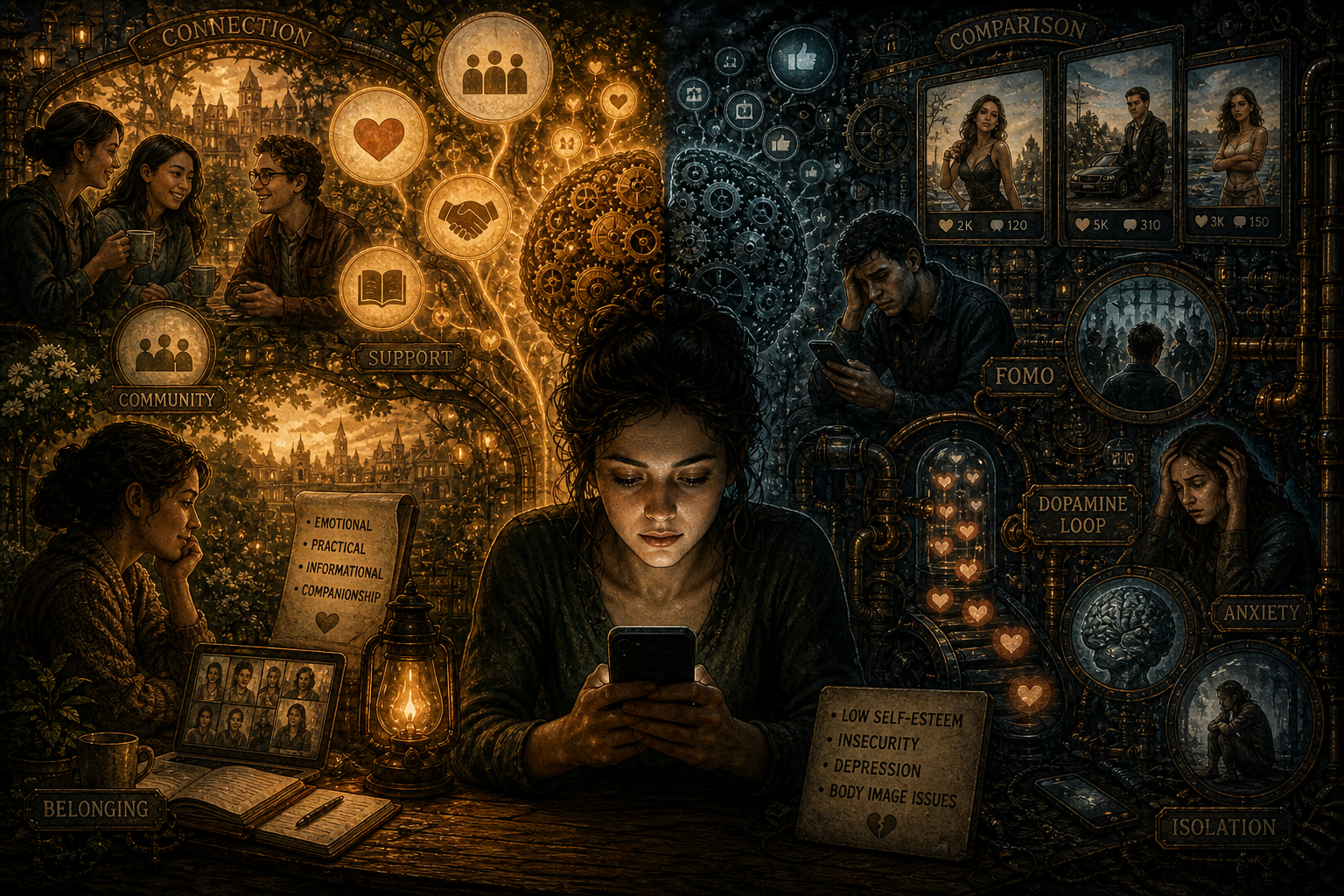
One of the most genuinely positive things that social media can provide — and this tends to get lost in the more alarming headlines — is a sense of social support. This is not a trivial thing. Research published in peer-reviewed journals has consistently demonstrated that perceived social support has a meaningful impact on both mental and physical health outcomes. People who believe they have access to support — emotional, practical, informational, and the simple comfort of companionship — tend to report lower levels of stress, anxiety, and depression. They also tend to cope more effectively with difficult life events. Social media, at its best, can be a genuine source of that support. Online communities built around shared experiences — illness, grief, parenthood, neurodivergence, minority identities, niche interests — can provide a sense of belonging and understanding that might be genuinely unavailable to someone in their immediate physical environment. For people who are geographically isolated, physically limited, or who belong to communities that are marginalized or underrepresented in their local area, the ability to connect with others who truly understand their experience can be deeply meaningful and genuinely life-improving. This is not a small thing to dismiss.
At the same time, it would be dishonest not to acknowledge the significant grey area that the word “perceived” introduces into this picture. Social support that is perceived is not necessarily social support that is real in any deep or durable sense. Online interactions can be superficial and fleeting. They can disappear without warning when a platform changes its algorithm, a community fractures, or someone simply stops logging in. The absence of face-to-face contact — the physical presence, the eye contact, the tone of voice, the involuntary signals that human beings read and respond to constantly in in-person interaction — makes it genuinely harder to form the kind of deep, reciprocal connections that psychologists have long identified as most protective for mental health. Receiving fifty comments of support on a difficult post can feel meaningful in the moment, and sometimes it is. But it is different from having one person sit with you in a room. Both things can be true simultaneously: social media can provide real value as a source of support while also being structurally limited in the depth of connection it is capable of facilitating.
Perhaps the most well-documented psychological risk associated with social media use is the impact of social comparison, and it is worth spending some time on this because the mechanism is more insidious than it might first appear. Human beings are social creatures who have always compared themselves to others — this is not a pathology introduced by Instagram, it is a fundamental feature of how we navigate social hierarchies and assess our own standing. What social media does is change the context and the content of those comparisons in ways that are psychologically significant. The people we compare ourselves to on social media are almost universally presenting edited versions of themselves. Carefully selected photographs, highlight reels of achievements and experiences, professionally curated personal branding — the content that gets posted is, by its nature, a best-of compilation rather than an accurate portrait of a life. The problem is that we know this intellectually and still respond emotionally as though what we are seeing is real. We scroll through images of other people’s holidays, relationships, career milestones, and bodies, and some part of our brain processes all of it as evidence of how life is — for them, and by comparison, for us. The result is a loop of upward social comparison that is difficult to exit and that consistently produces feelings of inadequacy, insecurity, and low self-worth in a significant proportion of users.
This effect is amplified, not accidentally, by the platforms themselves. The algorithms that govern what content appears in a feed are optimized for engagement, and the content that drives the most engagement tends to be content that is visually striking, emotionally provocative, or socially validating — which, in practice, means content that is far removed from the ordinary texture of most people’s daily lives. A post showing someone’s meticulously decorated home, extraordinary holiday destination, or remarkable physical transformation will consistently outperform a post showing someone’s Tuesday afternoon. The cumulative effect of spending time in a feed that has been algorithmically curated to surface the exceptional is a distorted sense of what normal looks like — and a corresponding sense that one’s own life is falling short of a standard that is, in reality, largely fictional. For adults, this is difficult enough to manage. For younger people, whose sense of identity and self-worth is still forming and who often lack the perspective to contextualize what they are seeing, the psychological impact can be considerably more damaging. Research has drawn links between heavy social media use and negative body image, reduced self-esteem, and heightened anxiety in adolescents, and these are findings that deserve to be taken seriously by parents, educators, and platform designers alike.
There is also a neurological dimension to this conversation that helps explain why so many people find social media use difficult to regulate even when they are aware of its negative effects on their mood and wellbeing. Social media platforms are, at the level of their fundamental design, engagement-maximizing machines — and one of the primary mechanisms through which they maximize engagement is the exploitation of the brain’s dopamine reward system. Dopamine is a neurotransmitter associated with pleasure, motivation, and reward, and it is released in response to experiences that the brain codes as positive — including, it turns out, receiving social validation in the form of likes, comments, shares, and new followers. The notification ping that tells you someone has responded to your post triggers a small but real dopamine release, and the brain, being the pattern-recognition and reward-seeking organ that it is, learns quickly to associate checking the platform with the possibility of that reward. This is the neurological basis of what many researchers describe as compulsive social media use, and it operates on essentially the same principles as other behavioral patterns driven by variable reward schedules — the unpredictability of whether checking your feed will produce something rewarding or nothing at all is, paradoxically, more reinforcing than a guaranteed reward would be. Understanding this mechanism does not make it easier to resist, but it does make the experience of finding social media difficult to put down considerably easier to understand without self-judgment.
Closely related to this dopamine-driven compulsion is the phenomenon of FOMO — the fear of missing out — which has become one of the defining psychological experiences of the social media era. FOMO is the anxious awareness that things are happening, experiences are being had, and connections are being made in spaces you are not currently inhabiting, and that your absence from those spaces means you are being left behind in some meaningful sense. Social media is an extraordinarily effective generator of FOMO because it provides a continuous, real-time window into what everyone you know — and many people you don’t — is doing at any given moment. The result for many users is a compulsive checking behavior driven not by genuine interest or enjoyment but by anxiety about what might be missed if the feed goes unchecked. This is a qualitatively different relationship with a communication tool than anything that existed before social media, and its psychological costs — increased anxiety, difficulty being present in offline experiences, disrupted sleep, reduced attention span — are increasingly well documented.
The relationship between social media use and clinical mental health outcomes such as depression and anxiety is an area of active and ongoing research, and it is important to approach it with appropriate care. Studies have consistently found associations between heavy social media use and elevated rates of depression, anxiety, and loneliness — but association is not the same as causation, and the picture is genuinely complex. It is difficult to determine, for example, whether social media use causes depression or whether people who are already depressed are more likely to use social media heavily as a coping mechanism. It is also difficult to separate the effects of social media use from the many other factors — sleep disruption, reduced physical activity, changes in face-to-face social interaction — that tend to accompany it. What the research does support with reasonable consistency is that the relationship between social media and mental health is not neutral, and that for a significant subset of users — particularly young people, and particularly heavy users — the net psychological effect leans negative. That is not an argument for abandoning these platforms, which offer real value and real connection alongside their risks. It is an argument for using them with considerably more intentionality and self-awareness than most of us currently do.
What is perhaps most striking about the psychology of social media, when you step back and look at it whole, is how clearly it reflects the broader complexity of human nature itself. We are social beings who crave connection, and social media gives us connection — imperfect, mediated, and algorithmically distorted, but real enough to matter. We are comparison-making creatures who are acutely sensitive to our social standing, and social media gives us an endless stream of comparison material calibrated to make most of us feel we are falling short. We are reward-seeking animals whose brains can be captured by variable reinforcement, and social media is one of the most sophisticated variable reinforcement systems ever designed. None of this makes social media uniquely dangerous — it makes it uniquely revealing about who we are and how our minds work. And perhaps that is the most useful lens through which to approach it: not as a technology that is doing something to us from the outside, but as a mirror that reflects back, with uncomfortable clarity, the parts of our psychology that we might prefer not to examine too closely.
